On Thursday 11 June, Transit Committee gathered for its June meeting. The meeting link can be found here.
The meeting centered around the Customer First Action Plan announced last month, and provided reasons to be both optimistic and pessimistic. The spalling problem seems to be receding into the rearview mirror, and the fleet is slowly improving, albeit with the temporarily cancelled trips (TCTs) still in place. However, this is not OC Transpo's first brush with great-sounding action plans which have not worked so well in reality, and their capacity for long-term planning and Council's ability to supervise such an undertaking remains in question.
The Stage 2 update and related talk has been quarantined into its own post again. That should hopefully be posted in a few days.
Documents list:
- OC Transpo Update - English
- Stage 2 Light Rail Transit Project
- OC Transpo Public Safety Strategy
- Motion - Saturday Service on OC Transpo Route 92
- Desroches - Response to Inquiry - Community Feedback for Limebank, Bowesville, and Leitrim Stations
- Carr - Response to Inquiry - Transit Station Elevators
- Carr - Response to Inquiry - OC Transpo Peak Ridership Definition and Service Planning
Overview
Timestamp 30:30.
The meeting began with an acknowledgement of Employee Recognition Month.
The meeting started with three inquiries. Marty Carr made one on elevator downtime, and asked whether there Rideau Transit Group had any contractual obligations with respect to Line 1 elevators. Staff said that they could withhold payments, but with everything else happening with Line 1, the chances of that actually having happened is slim. Glen Gower said he would follow up with the regulatory monitor on whether elevator uptime could be monitored (I suspect not).
Another Carr inquiry on peak planning received an indecisive response indicating that peak periods "generally" cover 0600-0900 and 1500-1800 on weekdays. A third inquiry from Steve Desroches asked about improvements at Limebank, Leitrim, and Bowesville station, especially with the latter's park and ride, but improvements cost money and Council has been hesitant to provide that money. Some self-reflection is needed.
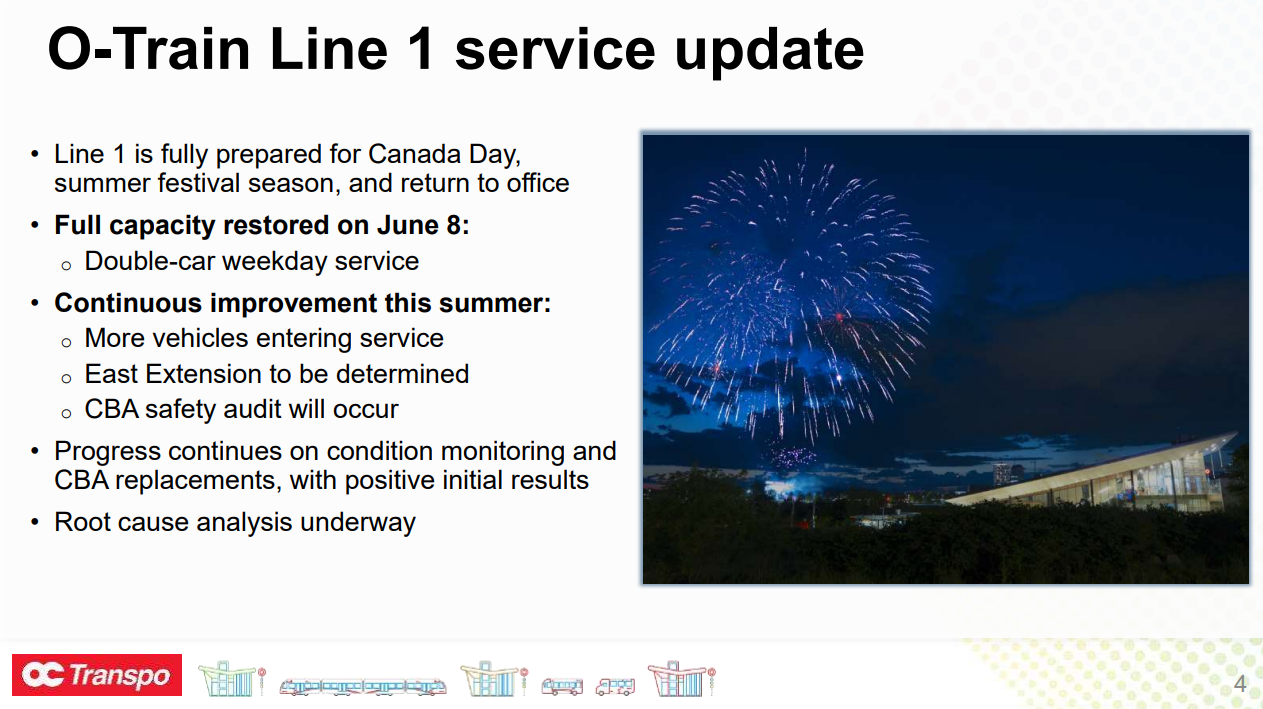
On 8 June, after four-and-a-half months of reduced single-car service due to spalling CBAs (cartridge bearing assemblies), Line 1 returned to double-car train service on weekdays. With this came a frequency reduction back to 10 minutes off-peak and five minutes peak despite Council direction, likely to reduce wear and tear on the fleet.
OC Transpo has begun preparing for summer events, including Canada Day and Bluesfest, as well as RTO4, which is imminent. RTG is continuing to replace CBAs and install bearing monitors to make a case for the lifting of the mileage limit which plagues the fleet.
OC Transpo acknowledged that unreliable service results not only in long wait times, but uneven crowding. This has significant implications for service planning, but it remains to be seen whether the agency will adapt.
General Manager Rick Leary also talked about runtimes and runtime reliability. This is something that OC Transpo has struggled with, and it is good to have someone talking about stable runtimes, even someone like Rick Leary (please excuse me while I wash my hands ...). However, the political constraints remain the same as ever - Council restraining costs and compliant management - and it remains to be seen whether they will share the same view after election season, or when it comes time to announce property tax increases.
There is one caveat with regards to runtimes. Wilson Lo brought up the example of York Region Transit, where Leary was general manager in the early 2010s, noting that the agency had a historical record of padding - that is, when buses are overscheduled rather than underscheduled - calling it "torture for riders." OC Transpo and Council must be careful not to swing from one extreme to another, though budget constraints will certainly be a natural check on padding.
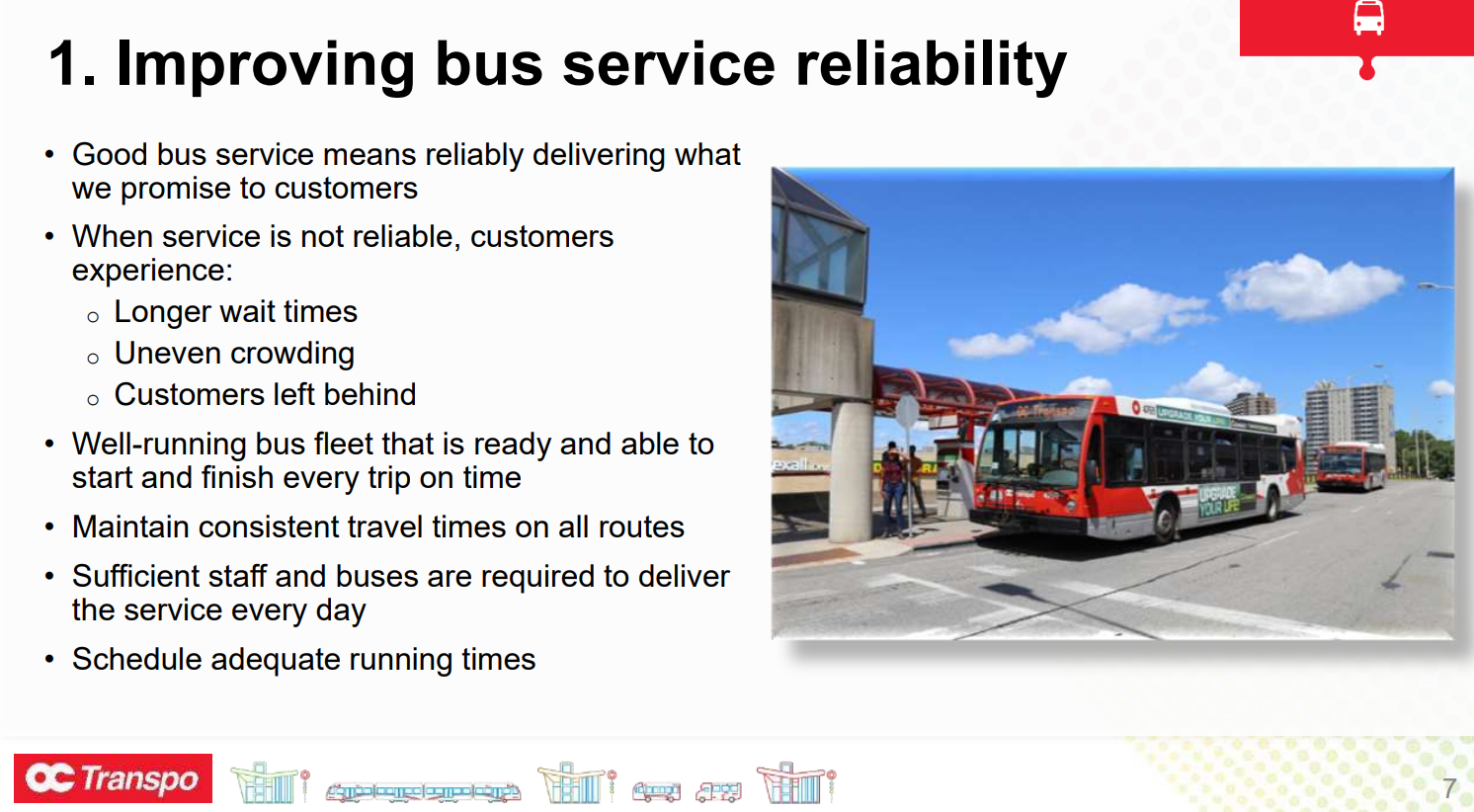
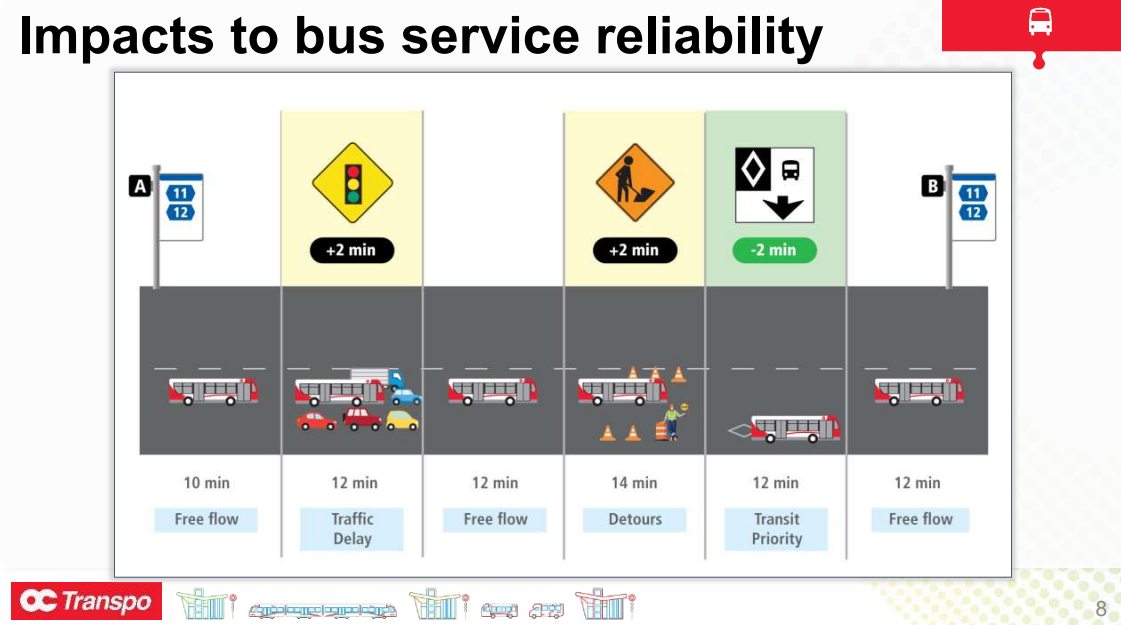
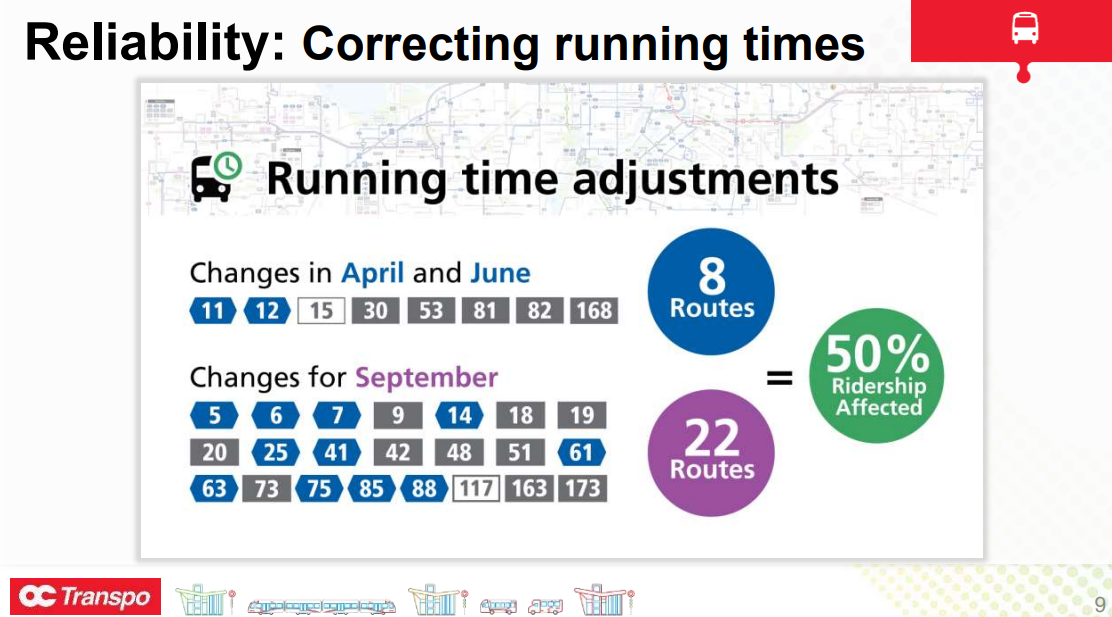
With this presentation, Leary announced runtime changes on a smattering of two dozen routes in September, following recent changes on eight previously underscheduled routes. If implemented properly, this will improve reliability and reduce schedule fragility. It remains uncertain whether the interlining changes proposed before Oliver Monahan's departure will be implemented. Staff reaffirmed the goal of scheduling routes at the 85th percentile of runtimes and layovers at the 95th percentile. In response to a question from Lo, they said that they will introduce a new KPI for on-time origin departures.
In a discouraging note, staff said that recent runtime changes were analyzed with "spectacularly complex math" when basic runtime analysis can be performed with pen-and-paper and some basic charts, no complex math required. The obsession with advanced technologies before mastering basic ones is harming OC Transpo's ability to perform basic functions of transit scheduling.
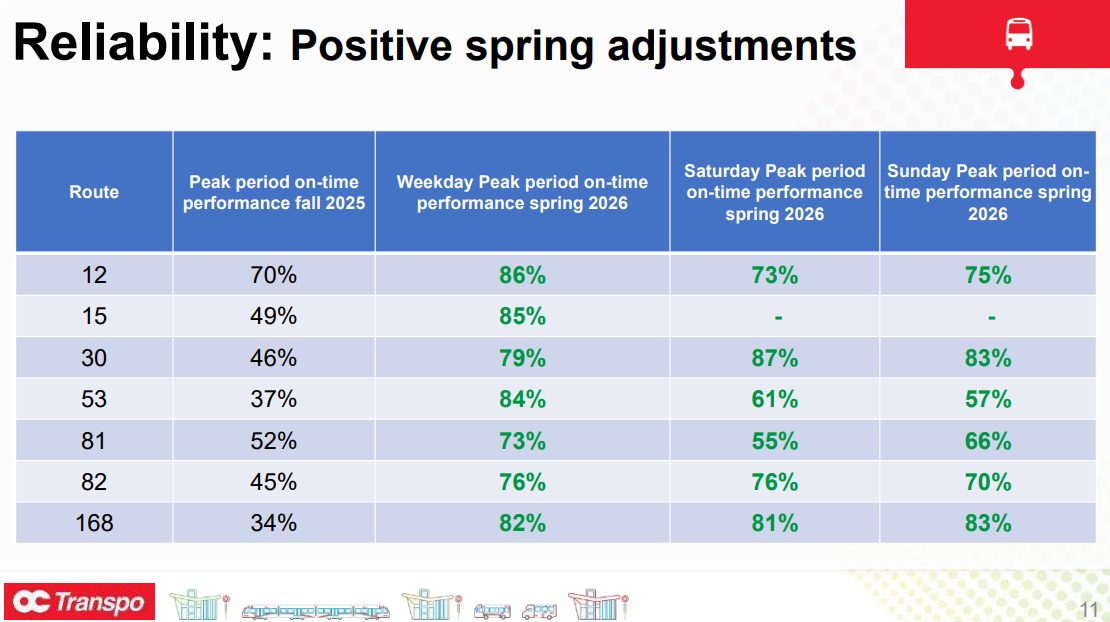
Staff presented on-time performance on the eight routes recently adjusted. Performance has improved significantly, but weekend performance is poor even though traffic levels are theoretically lower.
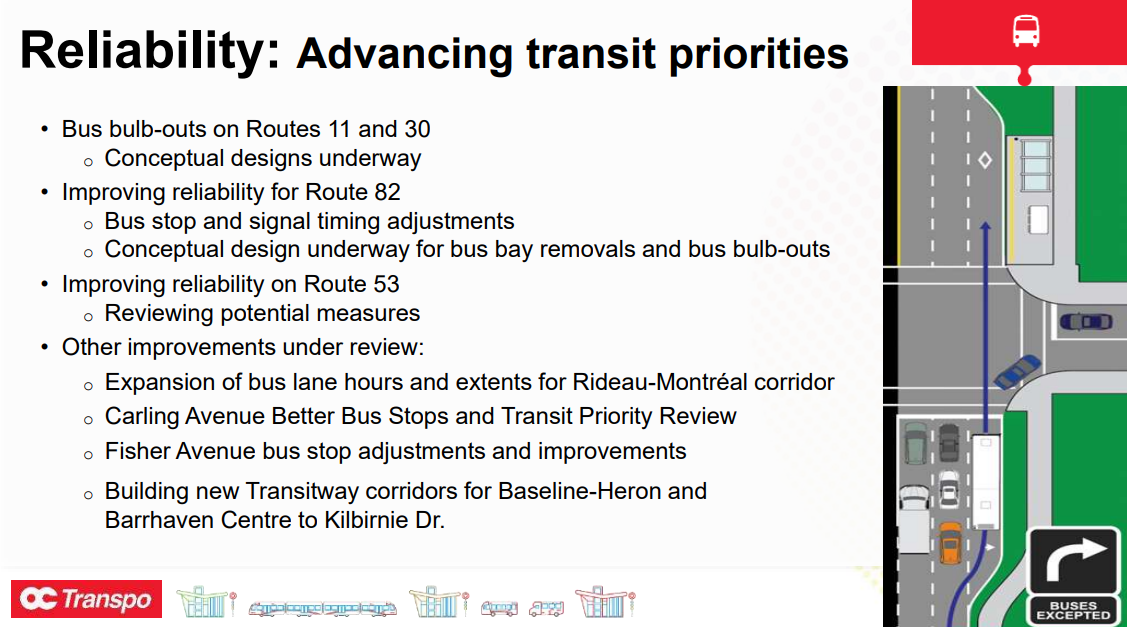
Transit priority measures are slated for Routes 11, 30, and 82. This is a subject I intend to write in more depth about, and I will not cover it here, but "cheap, fast wins" are rare. Carling is 20 years late for curbside bus lanes, Baseline BRT has been punted to other levels of government to fund in a classic City of Ottawa move, and other projects get watered down by councillor interference or gold-plated and made impossible to fund.
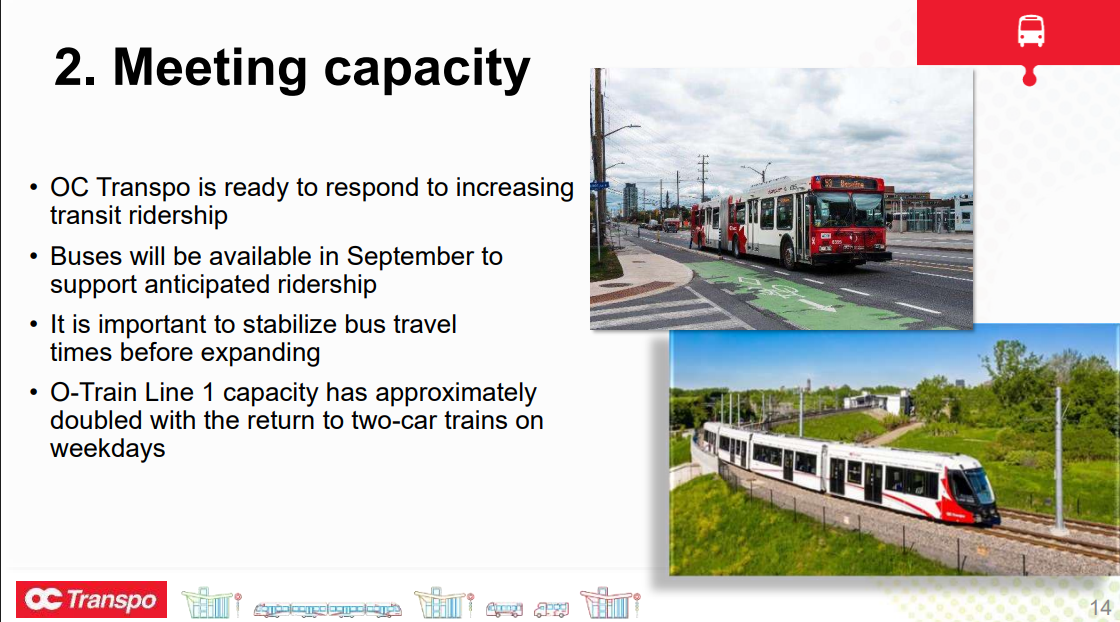
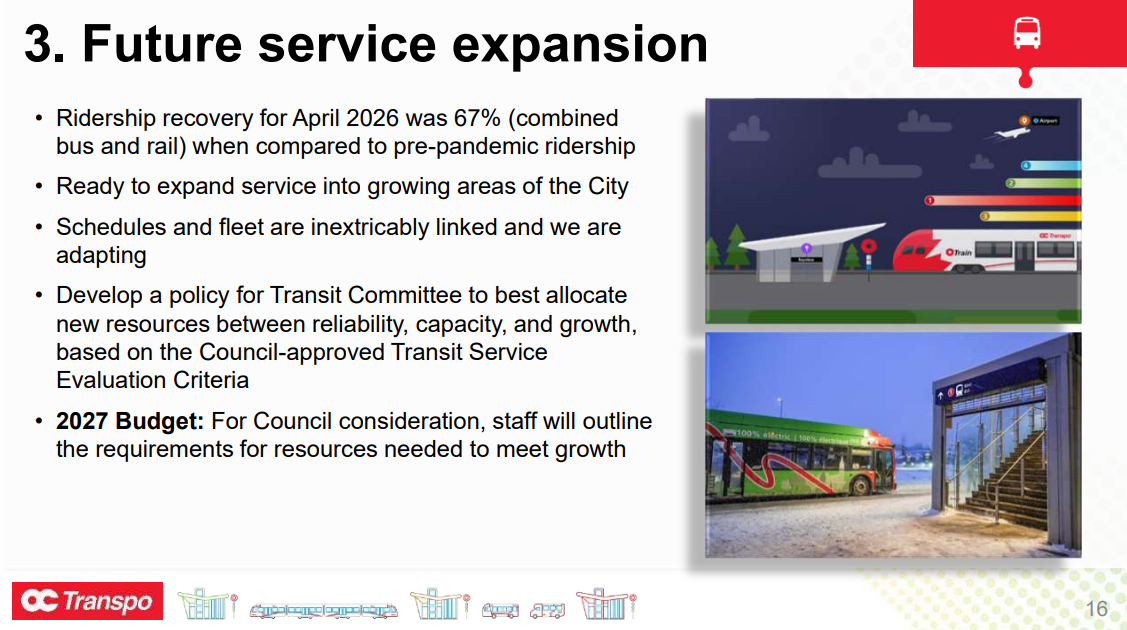
The spalling crisis has brought with it a sharp discussion about capacity needs. Staff talked about responding to increasing ridership, but 2026 ridership is decreasing, not increasing. Notably, in the absence of Council direction, staff (likely at the behest of Leary) suggested that they will "stabilize bus travel times before expanding." OC Transpo is contemplating changes to routes 5, 8, 13, 24, 61, 62, 63, 66, 74, and 75 ahead of RTO4, although the changes themselves are still under study.
Staff also indicated that they will present a new policy on service tradeoffs using the 2021 Transit Service Evaluation Criteria. Leary said he would be more proactive in asking for growth resources. The effectiveness depends on the kinds of backroom conversations Amilcar had; if she requested resources and was denied, this is a waste of time; but requests where none had been seen before could be a game-changer. Jeff Leiper noted that even the reduced bus fleet of 704 is adequate moderate growth, and that is before accounting for Stage 2 East/West.
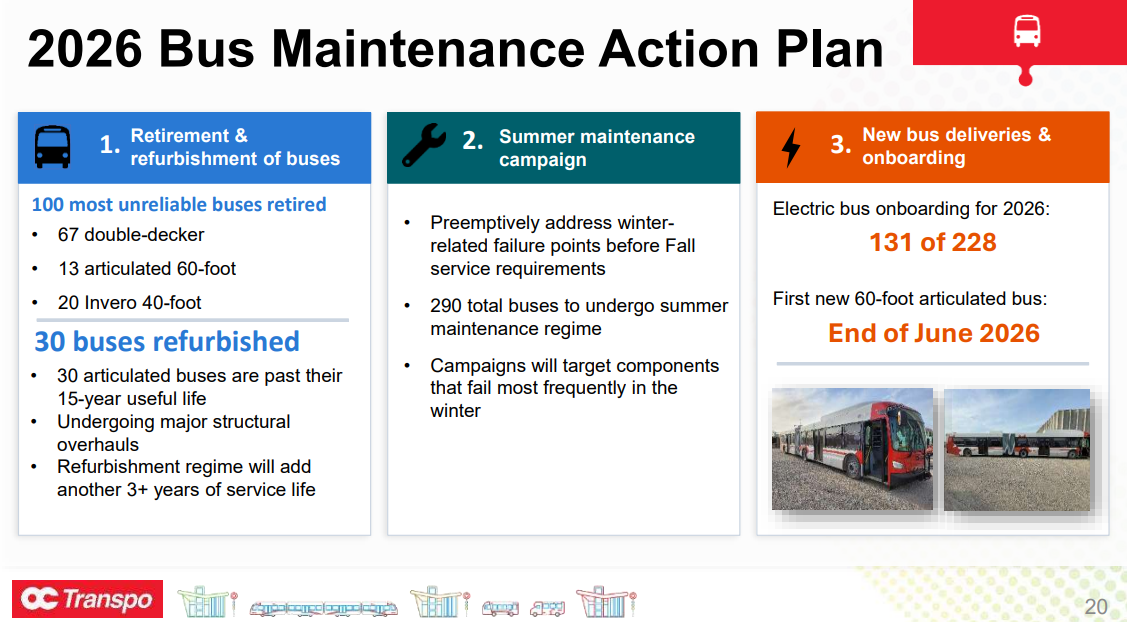
I previously covered that half of maintenance work was going towards reactive work, compared to an industry standard of 20%. OC Transpo aims to complete more proactive work this summer with its lower passenger levels and better weather, with 290 buses set to go through a summer maintenance program. Some skepticism may be warranted; OC Transpo presented similar plans last year, which pretty obviously did not work.
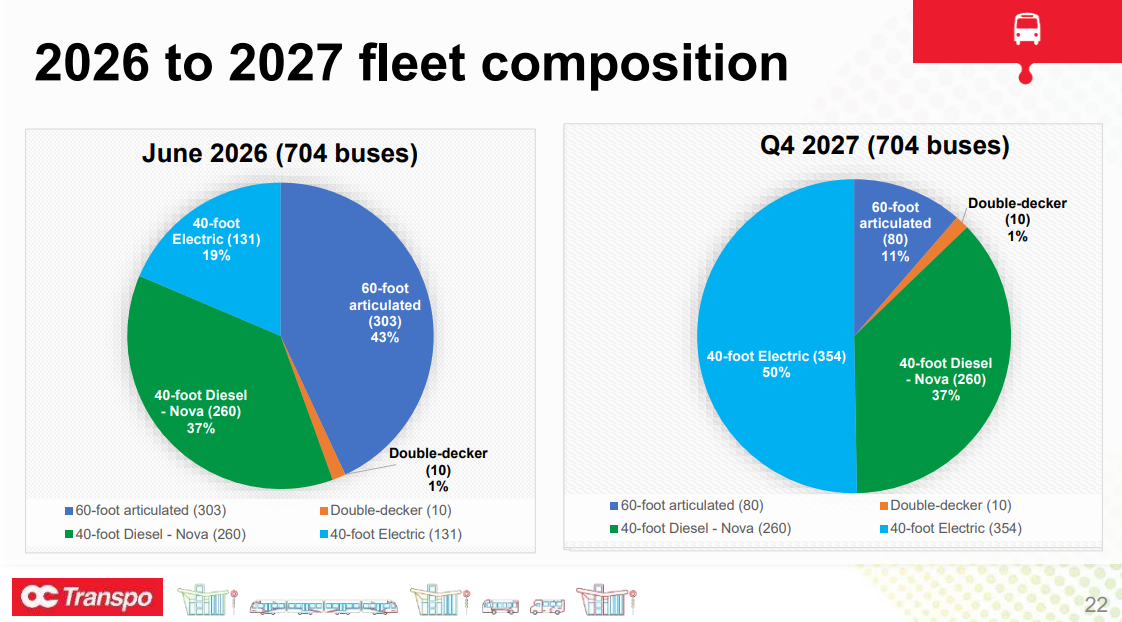
Additionally, 131 electric buses have been onboarded out of 228 planned in 2026, an acceleration from 182 planned buses in March; meanwhile, 30 articulated buses are undergoing refurbishment. In return, 100 diesel buses have been retired this year - 67 double deckers, 13 articulated buses, and 20 old "Invero" 40-ft diesels.
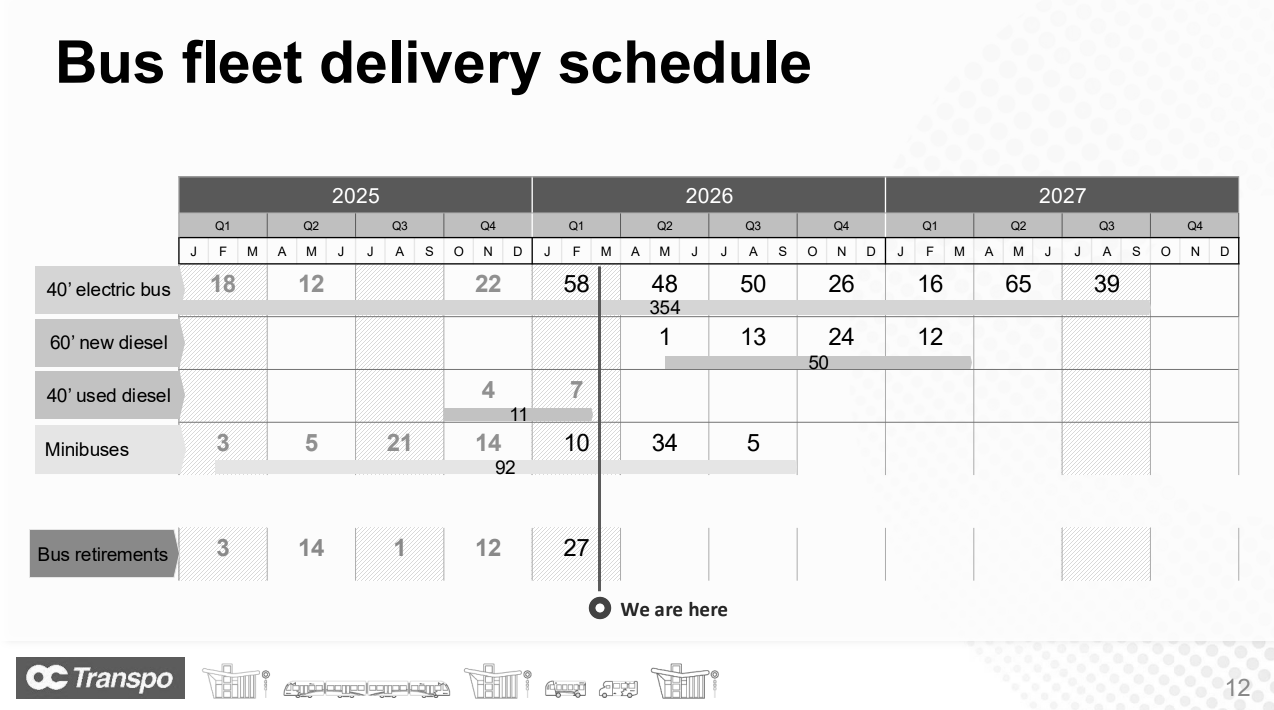
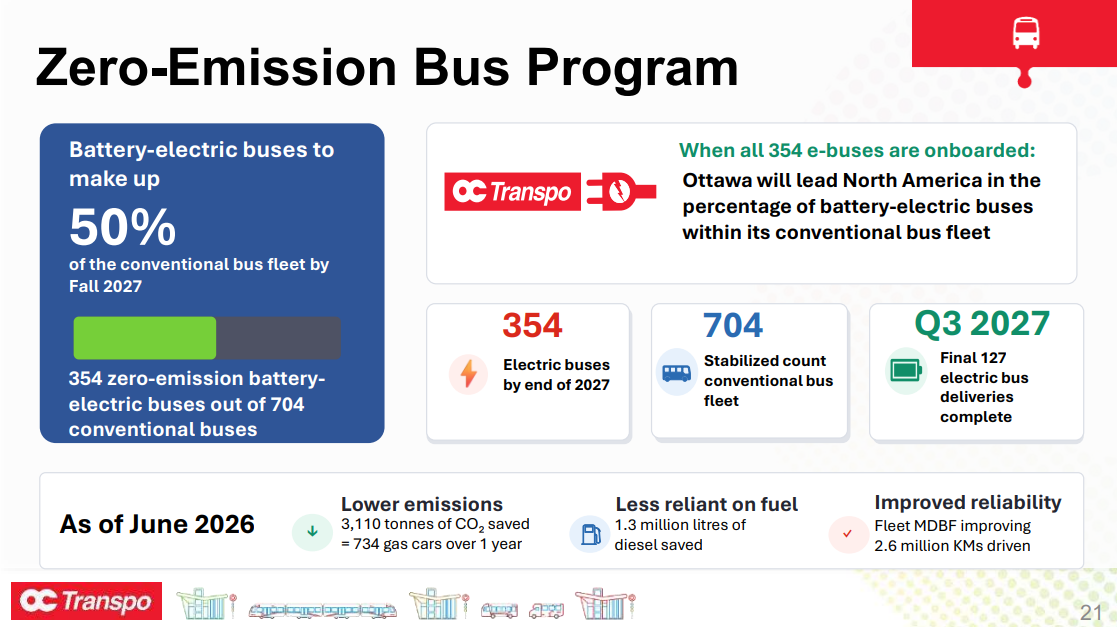
The bus fleet will be half-electric by the end of next year. OC Transpo says this will improve reliability and lower fuel costs - extrapolating from fuel savings, $40 million/year alone in fuel savings. However, the planned fleet size has shrunk again, from 738 buses in 2023 to 704 buses.
This shift in fleet composition begs a question which was only tangentially mentioned by staff: will there be adequate capacity? Given the agency's scheduling ineptitude and continued requirements for school service, it is unclear whether OC Transpo can ensure adequate capacity on busy routes, especially considering the poor reliability of bus service.
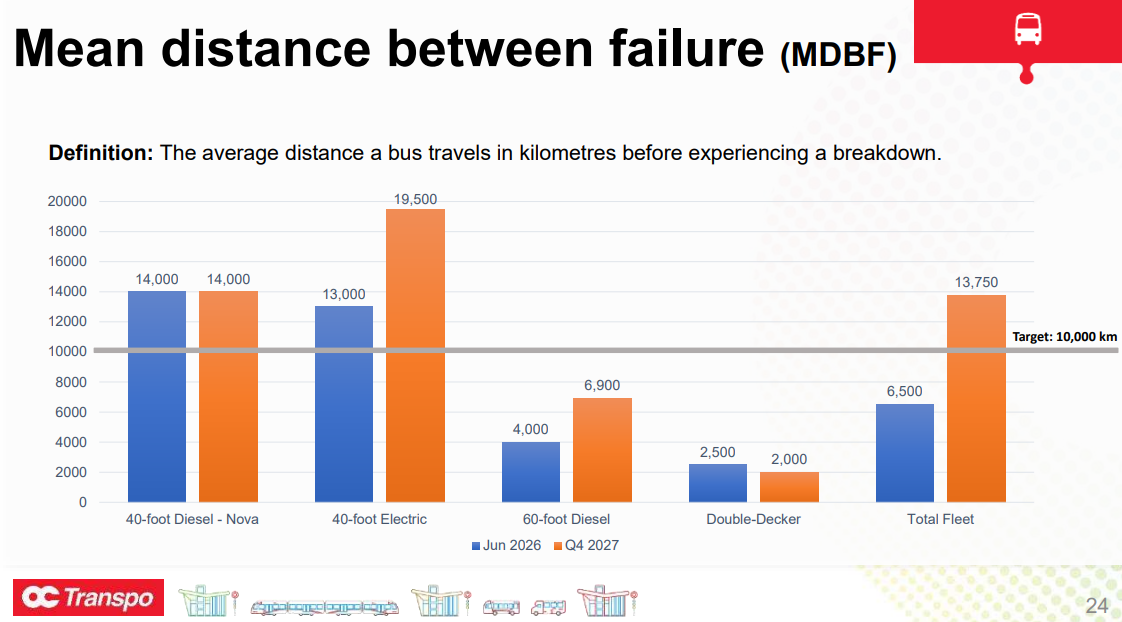
Staff introduced three new KPIs. The first, MDBF (mean distance between failure), measures how far buses run before mechanical failure. This metric was previously reported annually in the Five Year Plan updates, but with no stated target. Leary has set a target of 10,000 km, which is an industry standard - and the last update had fleet MDBF at under 6,000 km.
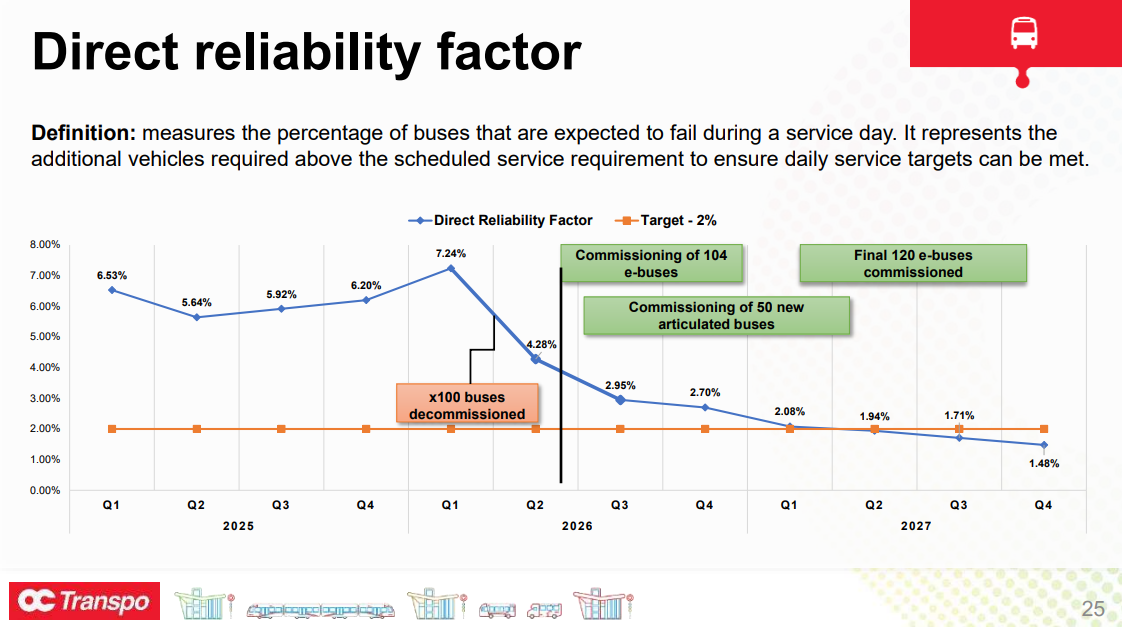
A second metric measures how many buses fail during a service day. This number reached a shocking 7.2% in Q1, not counting those with mere problems and continued to run, but is falling, and staff expect to see it drop below 1.5% by the end of next year. The target is 2%.
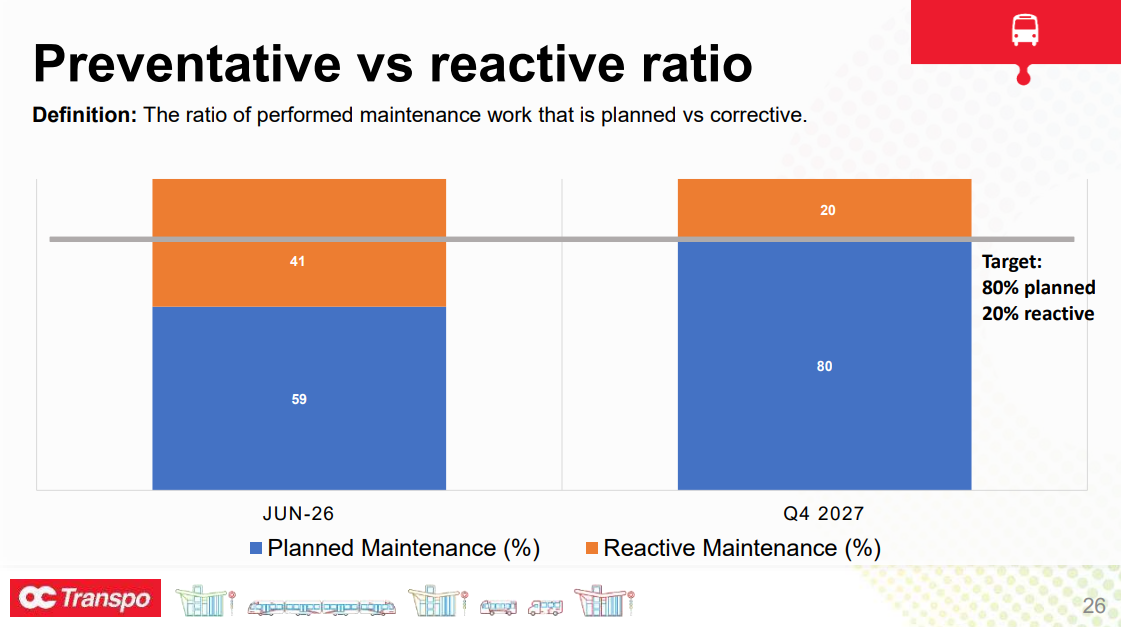
Finally, the ratio of preventative and reactive maintenance work is 40:60, meaning that work is going into fixing problems rather than preventing problems. This ratio was 70:30 in 2024! Staff aim to cut it to 20:80.
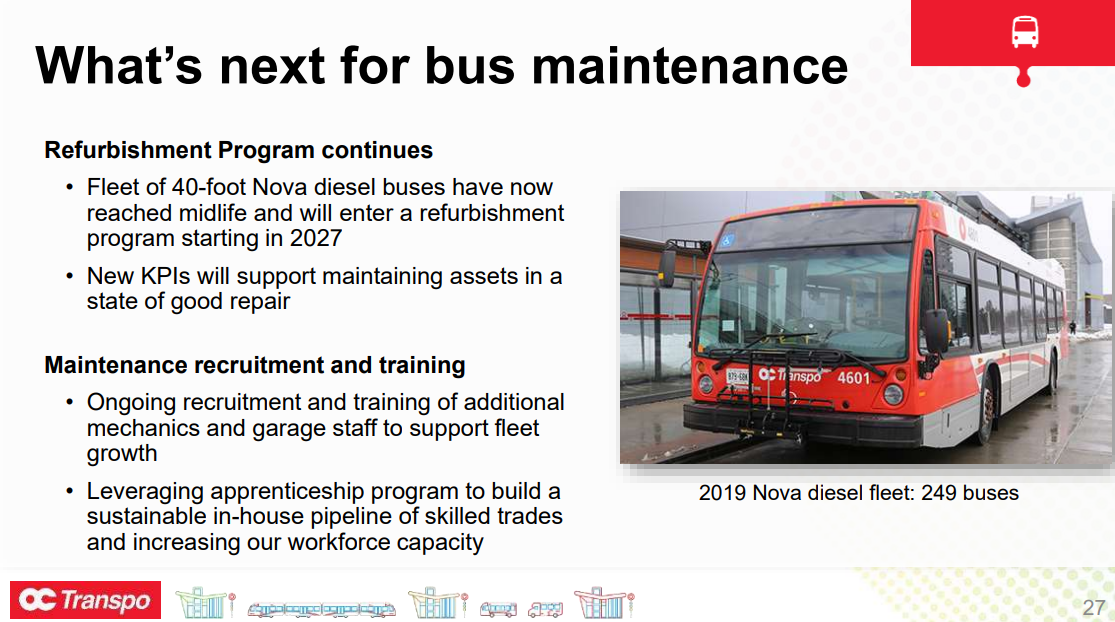
The 40-ft Nova buses, which were delivered in 2019-2020, are reaching the middle of their service life and will undergo a full refurbishment beginning in 2027. Given the e-bus delays, it would be wise to start considering replacements now - and this will be a major indicator of honesty in Leary's promised capital plan, which he said would be released to Council in the New Year. Leary blamed federal funding as a reason for large fleet purchases, an Ottawa classic, and said that he would try to convince them of the need for consistent funding, such as the Canada Public Transit Fund ... from which we are drawing tens of millions annually.
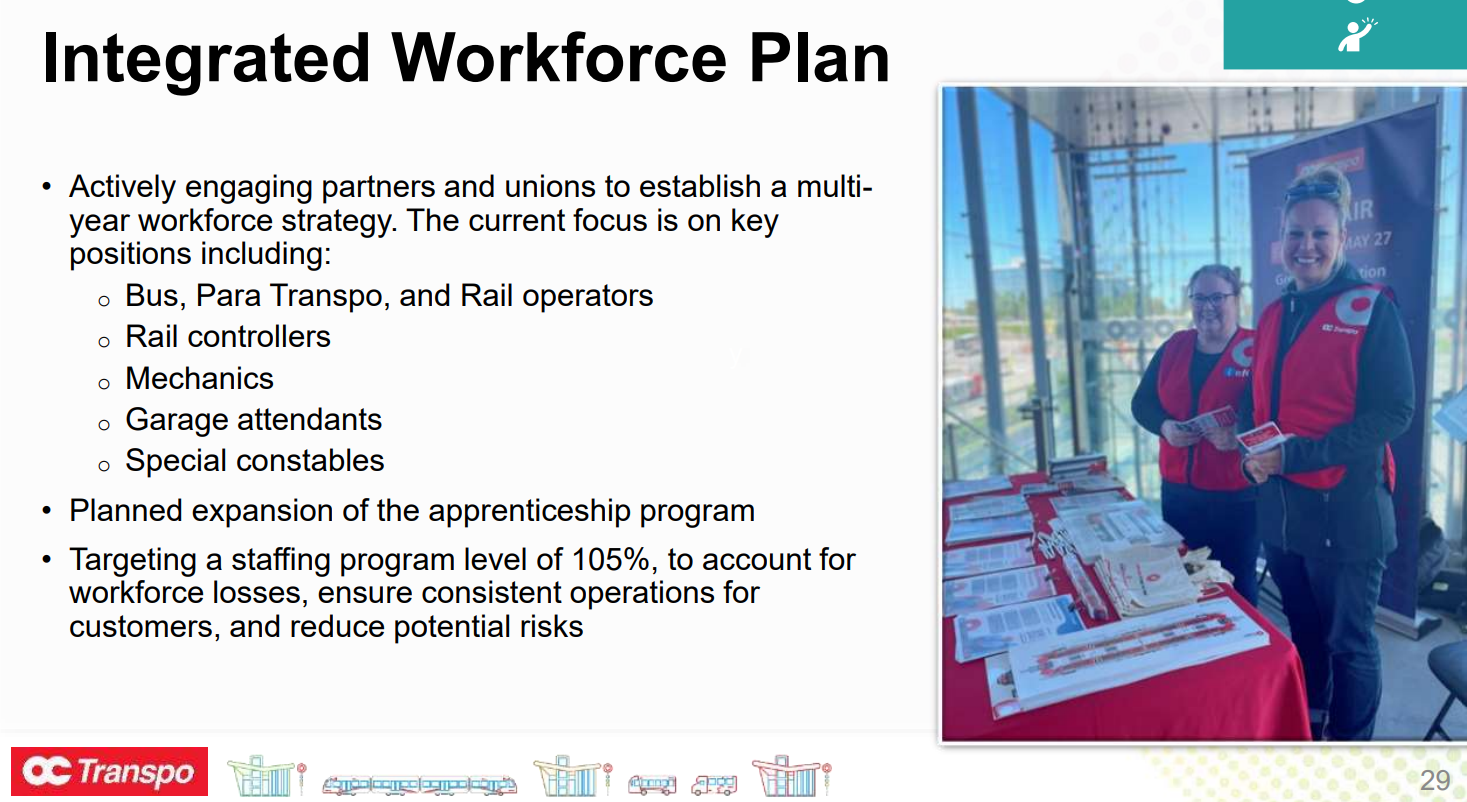
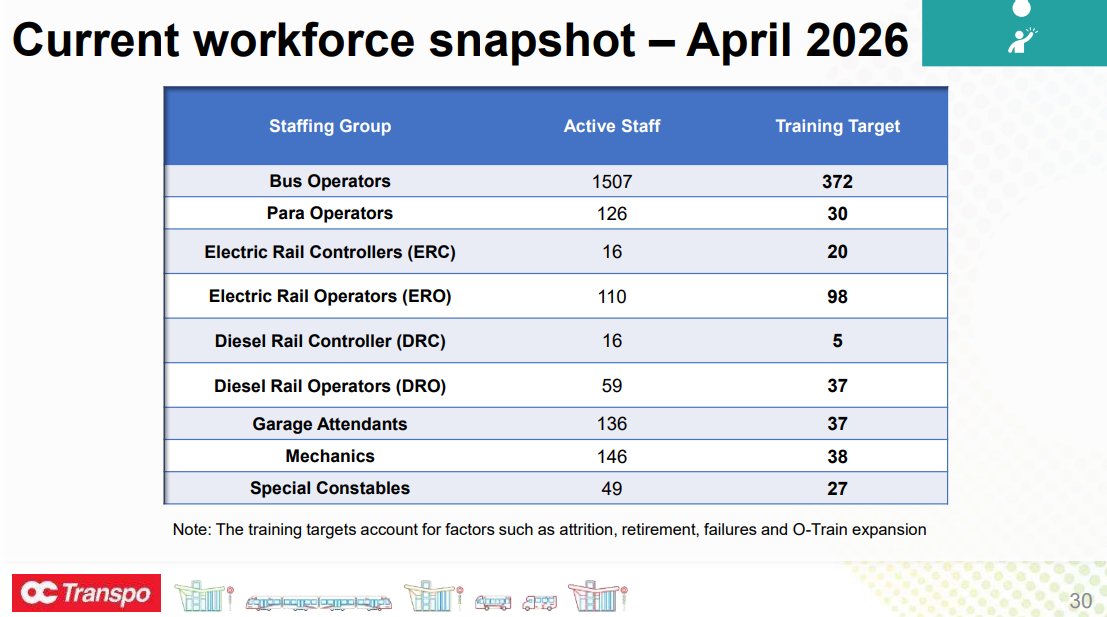
OC Transpo has developed a new workforce plan. Under the plan, the staffing target will be 105% to account for attrition, focusing on frontline and maintenance roles, including apprenticeship programs. There was also a snapshot of the workforce size, which can be seen below. No comparison of industry-standard attrition was made.
The numbers are difficult to compare, but a training target of 372 bus operators matches the rate from OC Transpo presentations in 2024; the 59 diesel rail operators is below the 66 target set before opening, and accounts for frequent Line 4 closures.
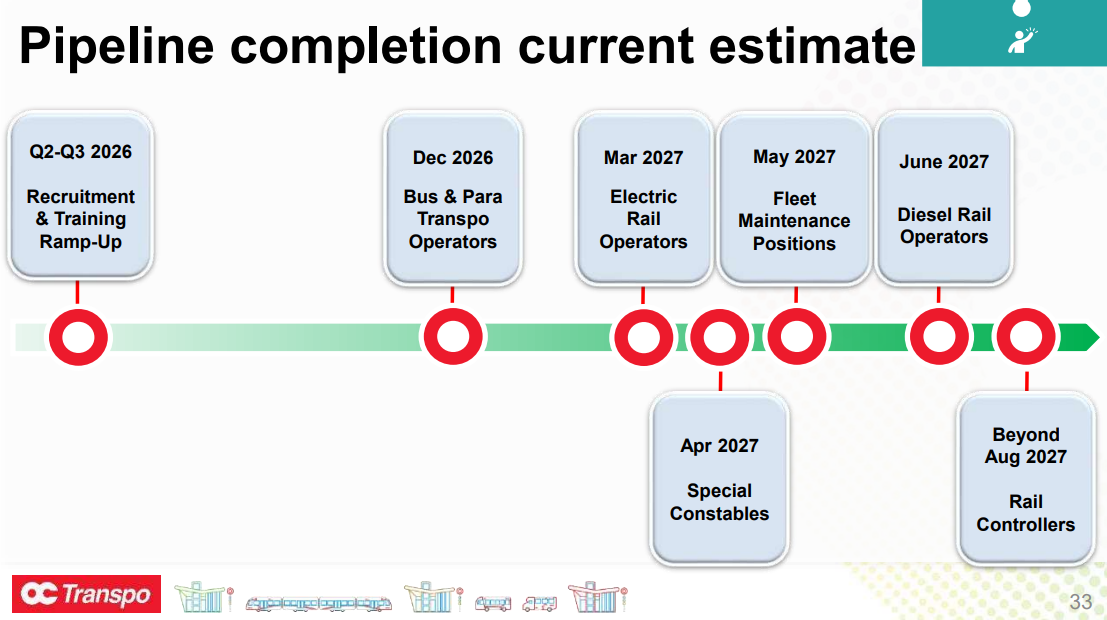
OC Transpo is ramping up recruitment (again?), and aims to fill its pipeline through 2026 and 2027. Notably, the last role to be filled are rail controllers, a shortage of which forced the closure of Line 1 last month. That is not a sustainable transit growth strategy.
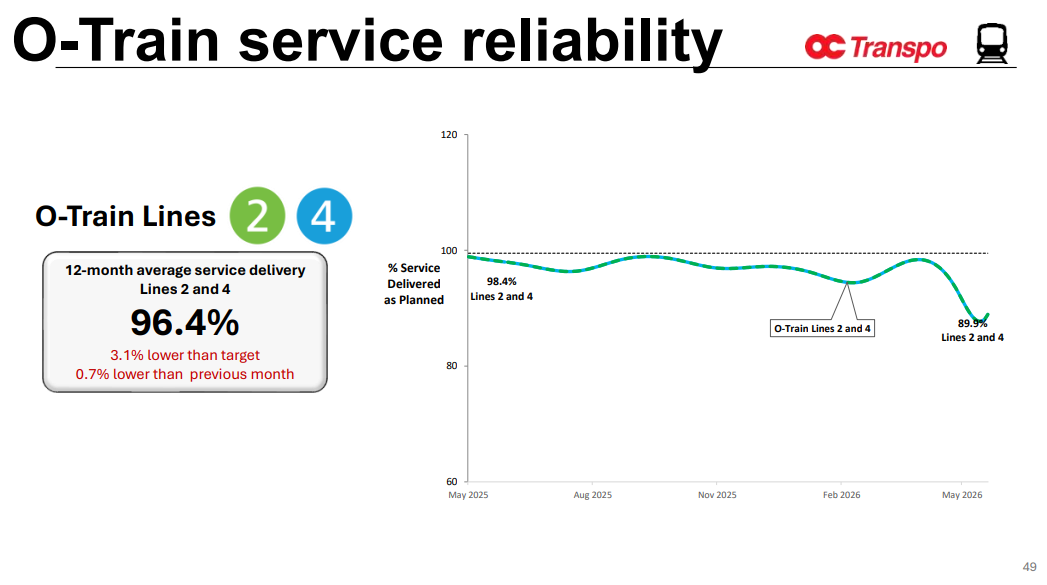
Among the (shocking for OC Transpo) admissions made is that even during the fleet crisis of the past six months, 29% of cancellations were due to lack of operators, and staffing shortages have driven down service delivery on Lines 2/4 from 98% to 90%. The new, unexpected honesty is appreciated, but results need to be seen.
Staff are developing a request for proposals (RFP) for a new advertising contract, expected to increase revenue by $2.3 million. This is welcome revenue, but its inclusion on a network-wide action plan is close to "deliberate misdirection". The impact of non-fare revenue on OC Transpo is minimal, as evidenced by the likely $50 million deficit this year. If only such a thing could have been predicted ...
Finally, staff talked about improving communications. This includes a monthly newsletter for councillors and their email lists delivered through the (competitor?) Next Stop Blog, which staff promised would be "honest, open, and transparent"; town halls; and marketing campaigns. No mention was made of open communication regarding cancelled and delayed service, and no marketing campaign is as effective as reliable service.
KPIs
Staff did not present the usual list of KPIs, but they are included in the slide deck. Many were not updated from April, so this will be KPIs: the abridged version.
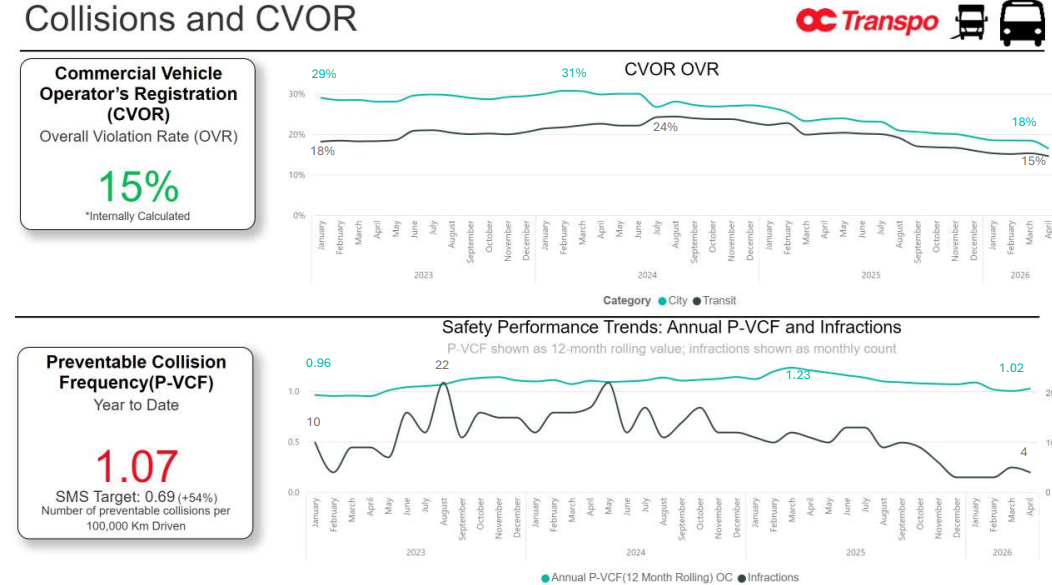
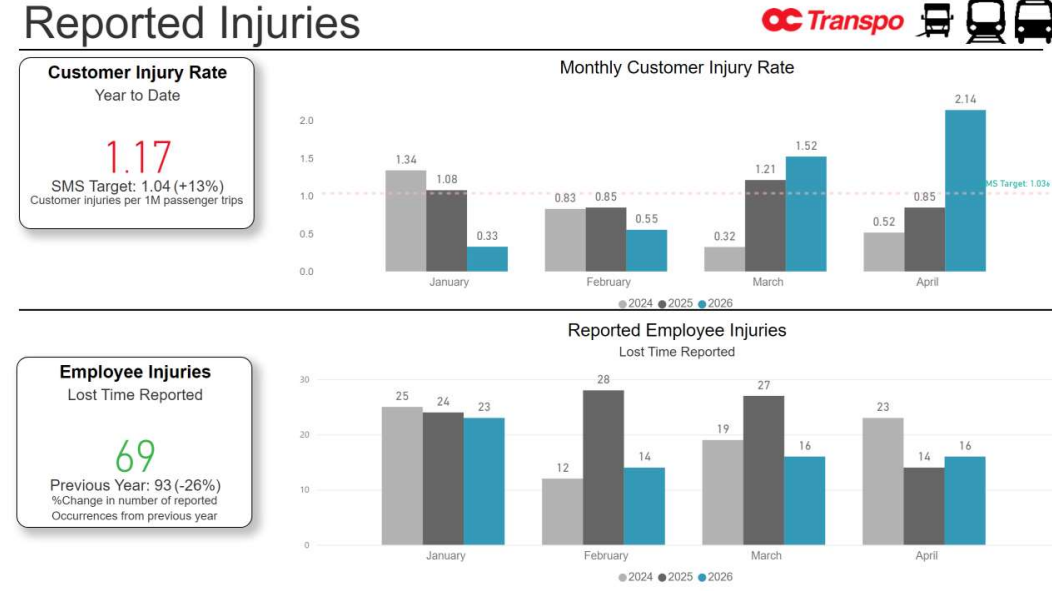
The commercial vehicle operator's registration violation rate remained at 15% through April, the same as in March. The preventable collision frequency jumped slightly to 1.02/100,000 km driven, up from 1.00 in March. The customer injury rate jumped significantly to 2.14/million trips, double the internal target; employee injuries increased from 14 in April 2025 to 16 in April 2026. Month-over-month, the violent offence rate dropped from 5.9 to 4.6.
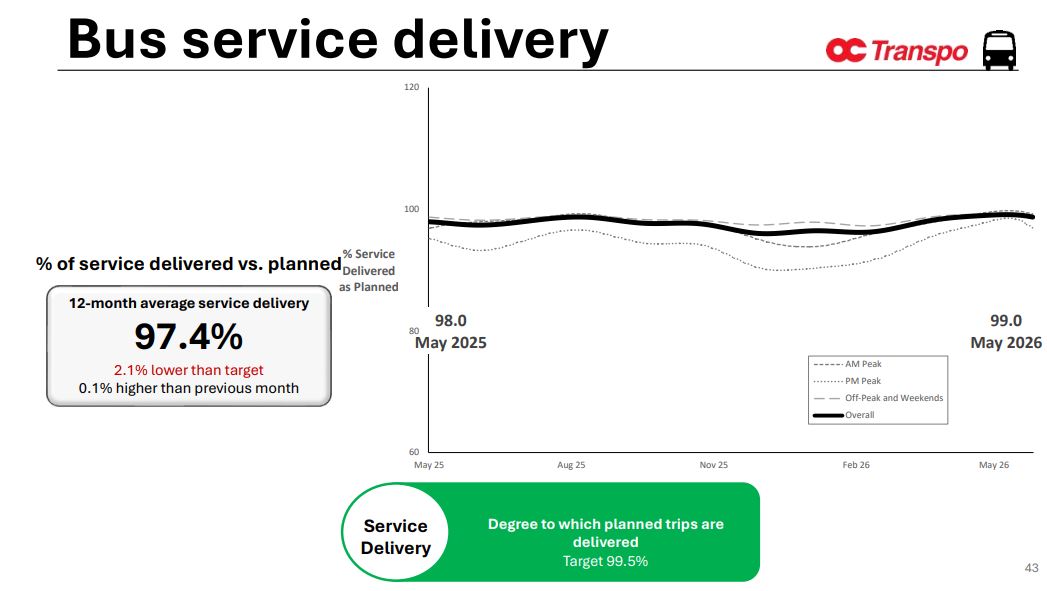
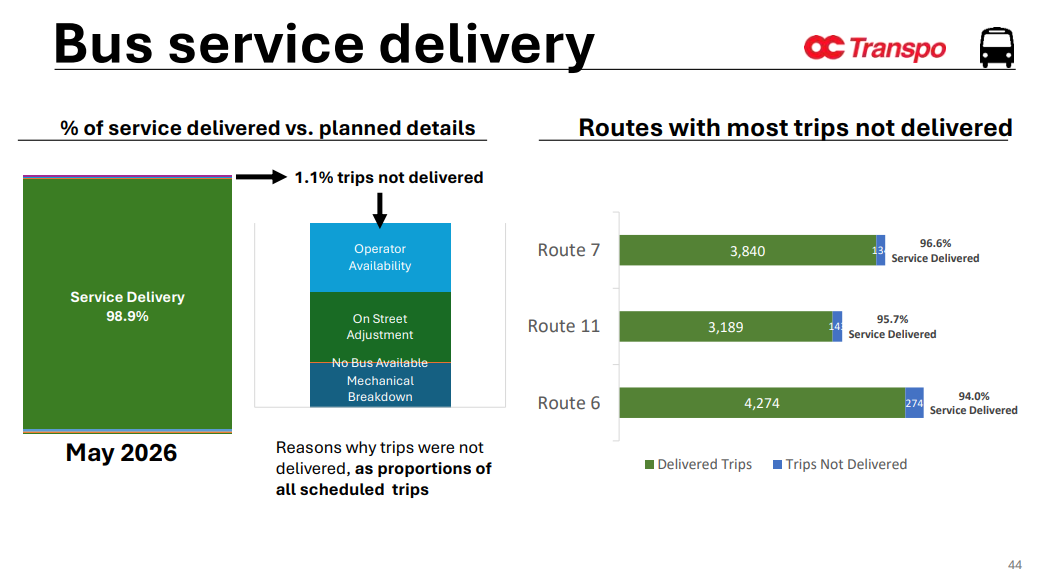
April ridership was 5.6 million, down from 5.9 million in 2025; meanwhile, Para Transpo ridership is up at 81,100. Service delivery (ie. non-cancelled trips) was 99.0% in May, an improvement from 98.7% in April, but this figure continues to exclude TCTs. This represents a cancellation rate of 1.0%. The routes with the highest cancellation rates were the 7 at 3.4%, the 11 at 4.3%, and the 6 at 6.0%. OC Transpo provided a breakdown of the reasons for cancellation, but as usual, without staff comments, it is little more than a pretty graphic on the page.
Bus "regularity," or non-bunching, was 85% on frequent routes; on-time performance was 74% on less frequent routes with 11% of trips arriving early and 19% arriving late. Para Transpo punctuality fell to 92%, driven by a sharp decrease in minibus performance. The usefulness of the 30-minute pickup window will remain unanalysed by necessity.
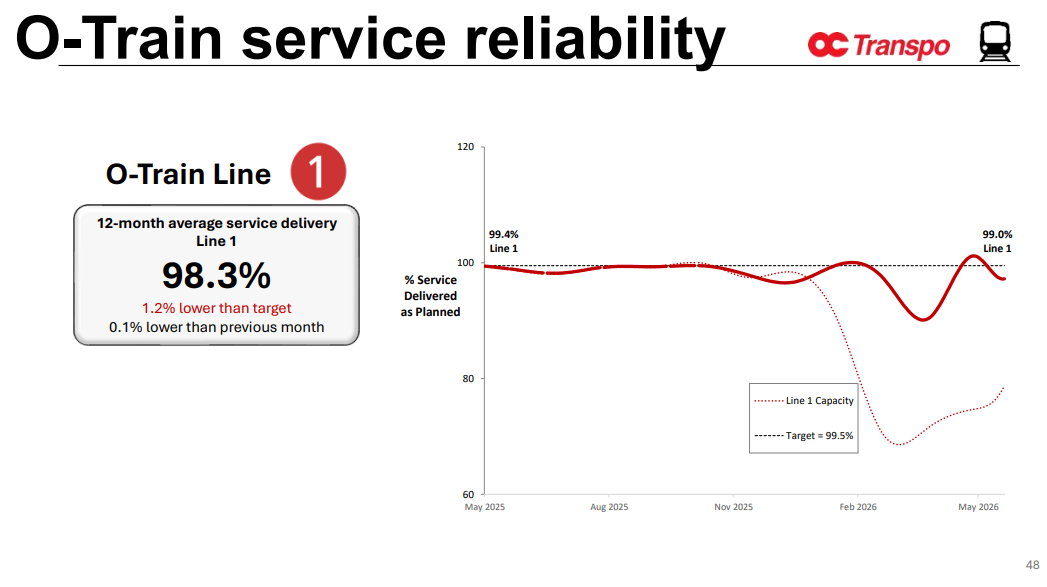
Line 1 service delivery was listed as a dishonest 99.0% in May, despite reduced capacity. The capacity gap was not listed, and because OC Transpo is allergic to grid lines, no analysis is possible. Lines 2/4 delivery remained low at 89.9% due to the aforementioned staffing issues.
The Public Safety Strategy
Timestamp 5:11:10.
Staff provided an update on the Public Safety Strategy, which was first introduced at Transit Committee last November. More information on the strategy's eight planks is available in that post.
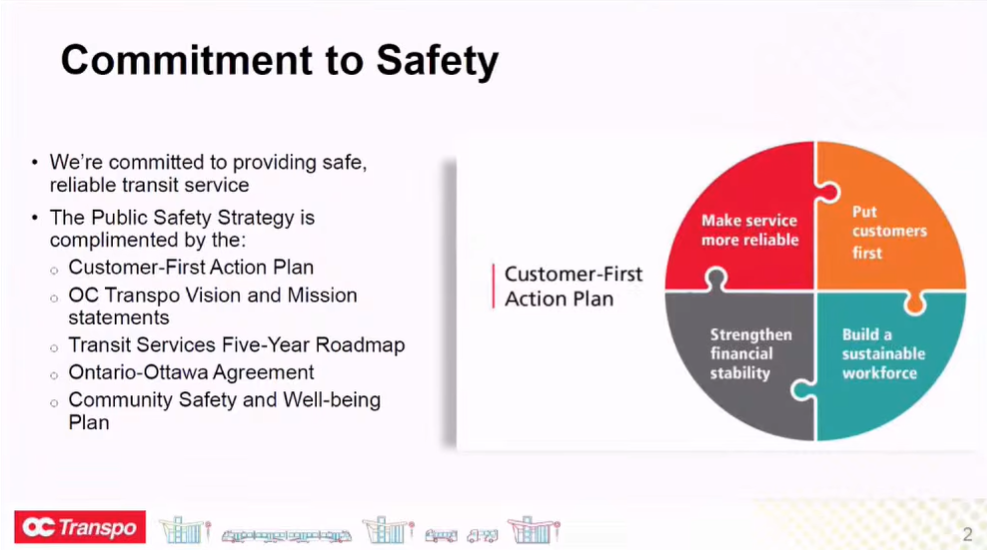
The plan is partly paid for with provincial funding. As part of the Ontario-Ottawa agreement, $48 million of money was allocated over three years for "public safety," split multiple ways. By implication, the funding allocation for the Special Constable program and associated items must be pathetic.
Council and management said that they would beg upper levels of government to continue to fund this program. But this framing calls into question the superficial sincerity of the City to safety, since they don't think it's important enough to fund themselves.
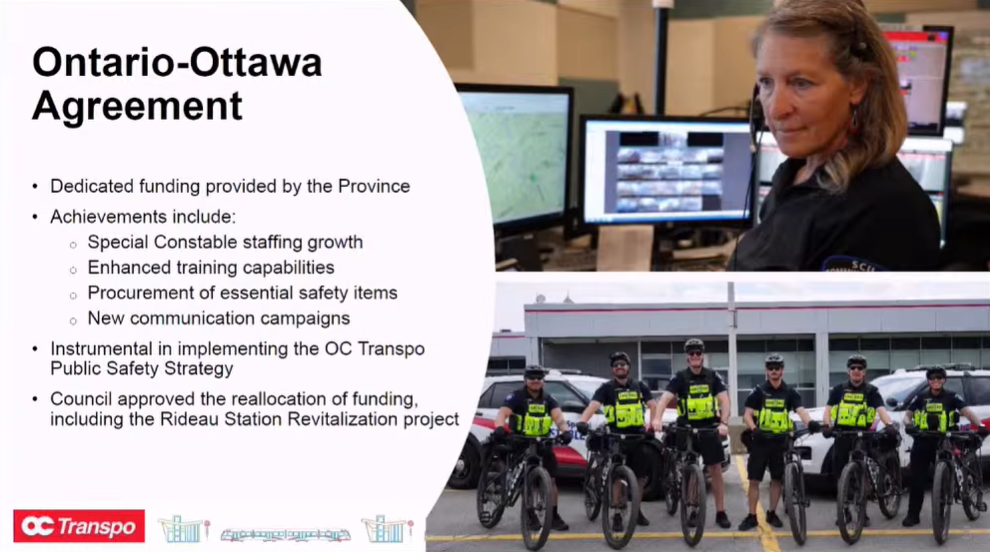
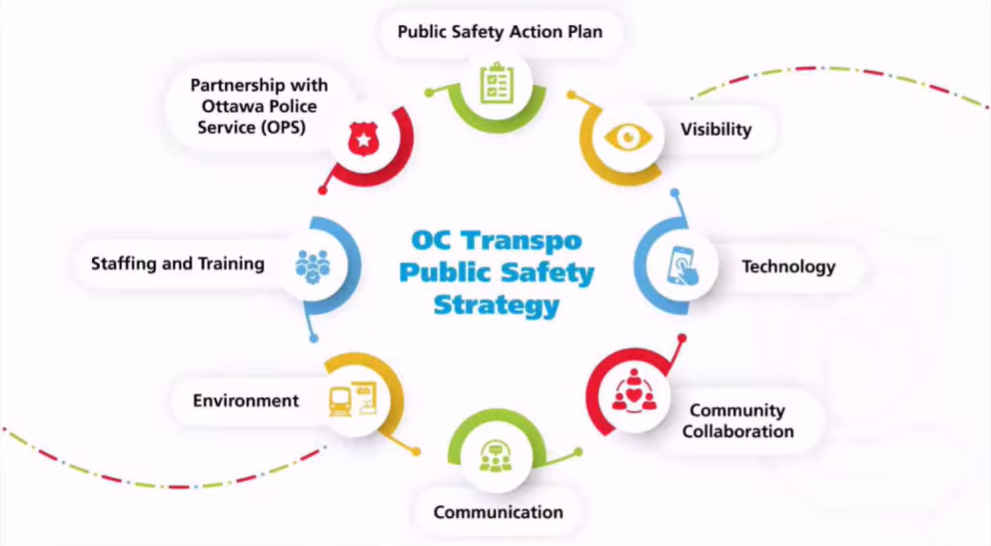
The Special Constable Unit Community Visibility Team launched in May, and staff noted "very positive community feedback". A new SCU location in the former Happy Goat at Rideau station and reopening the public washrooms are also listed as a part of the plan. The safety app for direct reporting is planned to launch this year. Finally, the SCU is implementing a new compassionate approach to homeless people on OC Transpo, with a joint team of social outreach workers and constables.
The plan will introduce more new KPIs. These will include the number of patrols, average call response time, violent crime rate, and a new fare evasion methodology that was first promised in March.
Odds and Ends
The meeting featured a number of delegations. Most of them were normal delegations, but two speakers were Neil Saravanamuttoo and Erin Coffin, candidates in this year's coming election. With this, Gower gave a pointed note that they should stay on-topic.
Saravanamuttoo, who is running for mayor, criticised the lack of a root cause analysis from the 2021 derailment and expressed skepticism over the LRT upload. He then mentioned his "buck a ride" proposal - one worth criticising at a later juncture - at which point Glen Gower stopped him from further comments. Coffin is challenging Allan Hubley in Kanata South. She talked about reliable service and bus connections for Kanata South.
Other delegations talked about reliable service, poor service on Para Transpo, slow travel times, and delays to Stage 2 East.
Carr asked about the status of the federal government and an employer-paid pass, which is "still at the conceptual level" according to staff. She also said that the 55% fare revenue target was outdated with the pandemic. Leary said that he was communicating with other levels of government on this subjects, adding that fare revenue has fallen across the country.
Riley Brockington said that OC Transpo should proactively make schedule changes, rather than wait for Council direction. But this waffling on responsibility is exactly part of the problem - councillors demand staff make tradeoffs on their behalf, then cancel those changes when they dislike the results.
Two inquiries were introduced. The first, from Carr, concerned broken fareboxes and fare machines. The second, from David Hill, asked about the bogies on Line 1 which have been the cause of so much trouble. The latter is likely to receive a private response, as it pertains to the P3 contract which requires secrecy.
Action Plans
Over the recent past, OC Transpo has had multiyear roadmaps and bus maintenance plans and action plans, and all of them have resulted in a continued deterioration of service.
In this meeting of Transit Committee, lots of good plans and proposals and words were laid on the table. But they will not mean anything unless Council funds more runtime, OC Transpo is able to wrestle staffing back into the green, and the agency is held accountable for missed deadlines, poor self-management, and unreliable service.
Too often, Transit Committee and Council have failed at their primary job in transit: oversee and govern the system. This meeting brought positive news, but it will require more than a few good meetings and reports to make OC Transpo a reliable, attractive transit service.
Until next time.

No comments:
Post a Comment